History
φ, Fibonacci, and firmitas et utilitas.
A name chosen slowly, and what it commits us to.
Most consultancies are named after their founders, or after a word that tested well. Phibon is named after a number, one that has been in circulation for something like two and a half thousand years and has still not been used up.
φ, the Greek letter, stands for the golden ratio: 1.6180339887, and onward for as long as anyone cares to keep writing. Fibonacci is Leonardo of Pisa, the thirteenth-century mathematician who brought Hindu–Arabic numerals into European use and, almost in passing, described the sequence that now carries his name. Put the two together and you get Phibon, and with it a working method: use numbers, and the principles behind them, to help people decide.

Nothing in the sequence is invented
Each number is the sum of the two before it: 1, 1, 2, 3, 5, 8, 13, 21. Every term is built entirely out of what already existed, and the further along you go, the closer the ratio between neighbours creeps towards φ.
That turns out to be a fair description of how we prefer to work. A project is not a fresh start. It is the sum of what a client already knows and what the previous piece of work established. We do not arrive with a template; we arrive with the previous two terms, and the job is to add them correctly.
The golden measure
The ambition inside the name is deliberate, and slightly immodest. φ is what the Fibonacci sequence converges on: the limit it approaches and never quite reaches. We would like Phibon to be the golden measure for strategic decisions taken on evidence. Not another opinion in the room, but the standard the decision gets held against.
The ratio has a habit of appearing wherever people are trying to get something right. In the proportions of a face. In the Parthenon. In the seed spiral of a sunflower. And in a drawing made in Venice around 1490, by a man who was reading a Roman architect.

The figure is drawn twice, arms and legs in two positions, inscribed at once in a circle and a square. Leonardo was making a case rather than a picture: that the body is proportioned, that proportion is where beauty comes from, and that architecture should imitate nature, because nature has already solved the problem.
Firmitas, utilitas, venustas
The case is not originally his. Writing in De architectura in the first century BC, Vitruvius set out three qualities a structure must exhibit: firmitas, utilitas, venustas. That it stand up. That it be useful. That it be beautiful. Two thousand years of building practice have not improved on the list.
Phibon’s signature takes the first two. Firmitas et utilitas: the work has to hold, and it has to be of use. Those are the qualities a client is entitled to demand, and they are the ones we are willing to be judged on.
The third is left unclaimed on purpose
Which is not the same as absent. Venustas is why a report carries an argument rather than a contents page, why a framework is small enough to remember a week later, and why this site is set on the ratio the firm is named after: its type scale, its spacing and its columns are all φ. Beauty here is not ornament. It is the evidence that someone understood the problem well enough to make it simple.
The construction
1 · 1 · 2 · 3 · 5 · 8 · 13 · 21 · 34 · 55
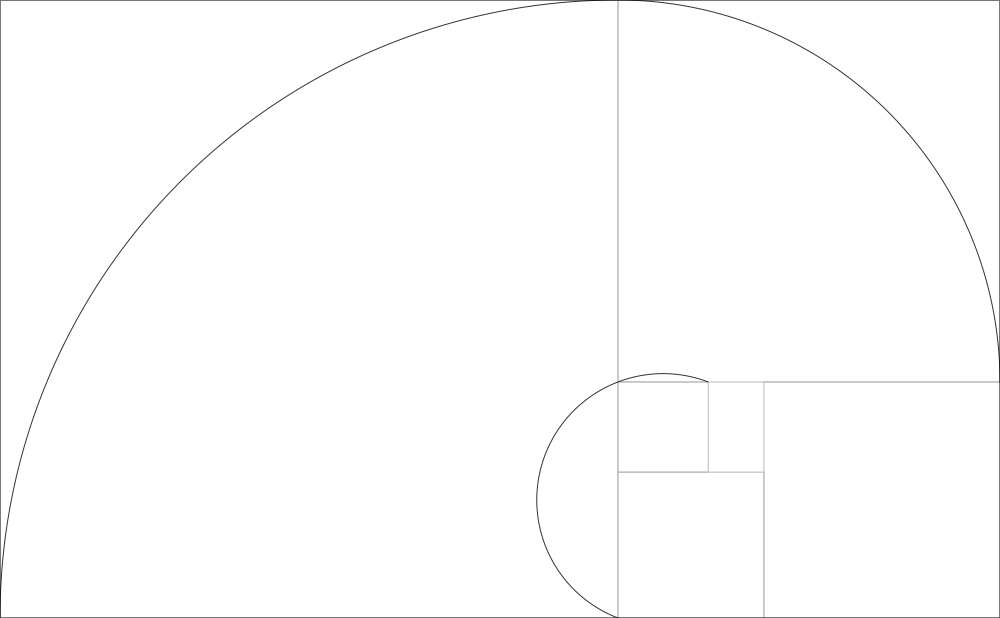
Each pair gets closer. None of them arrives. The spiral is the real construction: a golden rectangle divided into squares, with a quarter arc inscribed in each.
Archive
From the first history page
How the firm first explained its name, on the original phibon.eu.
We believe in the power of numbers and their ability to represent the beauty, utility, and sturdiness of a solution. Like the Fibonacci sequence, which shows that each number is the sum of the previous two numbers, we strive to build upon our past successes and achievements to continually improve and grow.
We strive to be the golden measure for strategic decisions based on data, just as the golden ratio is the answer to the Fibonacci sequence and its limits.
Everything in Phibon must follow a structured and organised notion of elegance and beauty, or more clearly, of venustas, a third unclaimed principle, but always present.
Method over method-speak.
Start with a two-week scoping review.